Friday, 22 April 2016

2016 : 4 WINDOWSPACE BEEAC - COMING UP


LEE MULLEN 

AW

May 2016

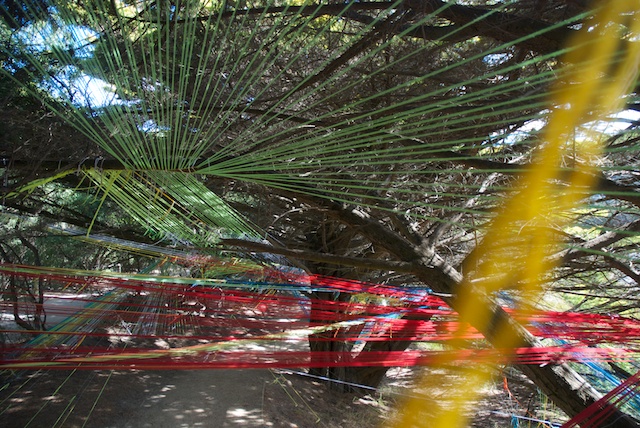
WINDOWSPACE BEEAC IS VERY MUCH LOOKING FORWARD TO HOSTING 
THE SITE SPECIFIC WORK 

AW

x LEE MULLEN


Wednesday, 13 April 2016

AMAZING CAROLYN CARDINET


CAROLYN CARDINET

has recently exhibited with the
LORNE SCULPTURE BIENNIAL


and at CASTLEMAINE WORA


                                          Now showing at KATOOMBA until 8 May:


Congratulations Carolyn!


Friday, 1 April 2016

2016 - 3 GEORGIA HARVEY 2 - 30 April 2016


Georgia Harvey

Quiet Chime, 2016


WINDOWSPACE-BEEAC
79 Main St BEEAC

April 2 – 30, 2016


'I enjoy exploring material behaviour and pushing materials to places
 they wouldn't typically inhabit ...' Georgia Harvey


Local Beeac Lakes, Corangamite and Weering, were a joyous discovery for ceramicist Georgia Harvey. The lakes in early 2016 are drying, some might say dying, but each stage and moment of their lives reveals other layers of life and substance. Each is a saline lake so when the waters recede they leave patterns and salt, that together, trace many extraordinary interactions. The many plants which live alongside them, and their cycles, refuse to give up and just go on offering their own extraordinary subtle colours too, their bands of growth mirroring, in their own organic way, the patterns in the drying beds. Even ‘unwell’ the lakes are a glorious and subtle vision, an inspirational natural resource in this lakes and craters precinct, in the Kanawinka Geopark that stretches to South Australia.


       Georgia Harvey, Quiet Chime (detail), 2016

Harvey began her visual career studying painting. From painting she followed a more sci-analytical trail and transitioned to work as a conservator, and it was while working in that field that she became, seduced is perhaps not too strong a word, by the aesthetics of ceramic figures from Precolumbian Mexico:
the colours straight from the earth but so vibrant; the speckles from various contaminants and streaks from the fire providing marks beyond the realms of the makers' hands; the subjects sometimes gory but often prosaic and recognisable. Most of all, the slipped surfaces buffed and honed to the finest satin finish like the perfect icing on a spicy lebkuchen … (from the artist’s website notes)

Ceramics are dynamic, and the sense of adventure, experiment and surprise they unite has fired Harvey’s particular fusion of science and the visual elements.


                                         Georgia Harvey, 2016

Speaking/writing of Danish ceramicist Trine Birgitte Bond, Harvey could have been describing her own approach: ‘…if something doesn't come out right she'll slap another layer on and pop it back into the kiln. I love her inquisitive approach and willingness to accommodate possible failure (indeed welcome it) in order to achieve these accreted surfaces …’

The scientist in Harvey is also stirred by the infinite curiosities that unfold from observation of thin section petrographs. The chemistry of surface is clearly crucial to Harvey’s feel for ceramics.


                                     'a thin section (petrograph) of gedrite ... not produced by 
                                                human hand - but probably present in any lump of clay
                                                you's care to pick up' GH
Alan Wallwork, a UK ceramicist, whose career and work Harvey has followed, may explain why she does so in the following.  Although they are not of the same generation, Wallwork beautifully describes the early stimulation of his senses:
‘… when I was little, out shopping with my mother. I could learn how things felt, as well as watch skillful things being done.  There was much to smell as well.  My mother bought sugar loose at Arthur East’s - a corn, seed and fuel merchants. This was a long bare wood floored cavern with a high wooden counter to one side. There, one of the brown coated men dug into one of the bins behind him with a grey metal scoop, tipped the contents into a gleaming brass scoop on his scales with their handsome brass weights, then poured out the sugar onto a big sheet of thick blue paper.  Then he did some origami and a plump parcel appeared without use of string, tape or anything else. Just clever folding.  I, meanwhile, was free to dive my hands into any of the long rows of bulging open sacks in lines down the shop floor, their tops neatly rolled down.  They held wheat, barley, oats, dried peas, beans, and on and on …’ http://www.alanwallwork.info/alanintro.html


                                Alan Wallwork, (‘wheat, barley, oats, dried peas, beans, and on …’) 2016


Wallwork writes also:  ‘it was the workshop itself I yearned for’ – another swoon of identification for Harvey who has not long moved into her own ‘workshop’ aka laboratory.  It is there in inner Melbourne she experiments with Weering and Corangamite salts in her kiln – ‘each piece has quite an extensive journey’ – dirt and fire, smoke and minerals – stirred, tamped and burnished with Harvey’s favourite humble tools:  wooden spoon, bamboo skewer, teaspoon. Nurtured accidents emerge from intuitively combined materials and surface tensions.

The work of Aneta Regel Deleu is admired by Harvey – her work is ‘loose’, organic and playful, yet its seemingly spontaneous substance hints at a darker deeper side. Below is an ARD ring:


                                                                       Aneta Regel Deleu, ring

Video collaborators, Panamanian artists Donna Conlon and Jonathon Harker – working with found-objects and rubble – are also a Harvey inspiration, a reminder of the beauty of the ephemeral and the hidden logic in apparent play. See their work here: especially juegos, (No 2 is this writer’s favourite)  –  http://www.donnaconlon.com/?p=419&lang=es

Ceramics, it seems, is the art of an unashamed collision of disparate inspirations brought together by artists devoted to materials and their alchemies. The work in WINDOWSPACE by Harvey, Quiet Chime,  (2016) – is beautifully described by her in the following way (it is): ‘the quiet response to an isolated/unusual landscape. For me the experience of visiting the lakes (under these particular circumstances - perhaps it would have been different if I'd just found myself there of my own accord) was like the chime of the bell that says 'wake up, pay attention to where you are'. I don't want to get too absorbed in the specific notion of meditation but it's definitely part of the artwork - certainly part of the process of making it, repetitive as it is. Just as important though is the material expression and how the surfaces reflect processes occurring naturally. eg The thin crackled tokens are similar physically to the crust of salt layer cracking underfoot.’

WINDOWSPACE-BEEAC is proud to welcome Georgia Harvey and her work, Quiet Chime, (2016), uniting as it does local materials and a seemingly infinite constellation of inspirations.  AS


                                          Preparation of Quiet Chime, 2016


Sunday, 20 March 2016

2016 : 3 WINDOWSPACE BEEAC - COMING UP


   COMING UP in April


GEORGIA HARVEY - quiet chime (2016)


                                 quiet chime, 2016 (detail)


WINDOWSPACE-BEEAC looks forward to the installation of Georgia Harvey's quiet chime (2016), the ceramicist's response to the Kanawinka Geopark lakes and craters precinct around Beeac.


Sunday, 28 February 2016

2016 - 2 CHACO KATO - 1-28 March


‘My work is always growing, growing, growing, very organic and I don’t really know where to go and how it’s going to turn out …’   
Chaco Kato, 1999, Talk – artists initiative – Conversation between Mary-Louise Edwards, Chaco Kato and Sandra Bridie

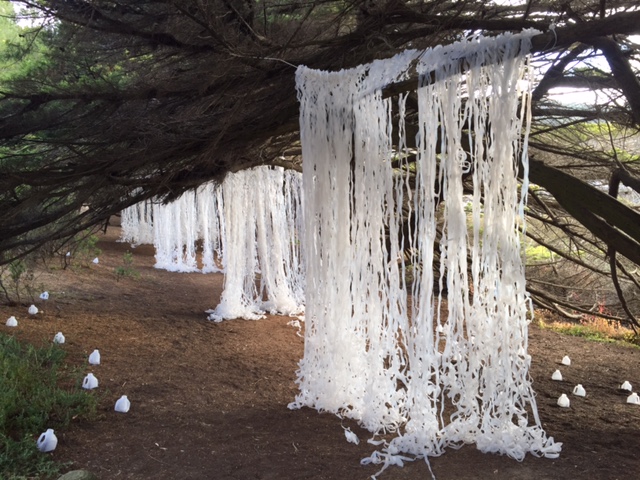
      Himo Theory 2# - Chaco Kato (2014) Lorne Sculpture Biennale - Photo: Anna Sande

Chaco Kato’s creations are ephemeral, fragile and poetic, cognizant of precarious interdependencies between art, humanity and nature. Kato frequently recycles found materials.

To my mind Chaco Kato’s work very much reflects her background. Kato grew up in a Japanese city surrounded by mountains. It is not often one writes of artists’ backgrounds these days – the art world is a global world, artists are peripatetic, it almost seems small-minded to put one in a box of cultural ‘background’. However I first met Chaco in 1998, two years after she arrived in Australia and it seems to me that her thinking and her artwork remain very much influenced by her homeland, (and its spirit), and that this is not a bad thing given the contemporary homogenizing of art that seems more often than not to threaten or eradicate (what I feel are crucial) cultural origins.

While indulging in this ‘background business’, it is worth noting too that Kato’s initial tertiary studies were in creative writing and I think, if I recall correctly, her artwork developed from a desire to illustrate her writing, particularly that work written for children.

Kato’s studies and studios have spanned the world – from Japan to the US, to France to Australia.  This global awareness of Kato’s is also a significant influence, in the sense that it seems, ironically, to have allowed her to stay closer to her origins, and yet to care about ‘the whole’. Or perhaps it is her Buddhist belief, carried everywhere, an indelible tie between life, death and rebirth, ‘the circulation of lives’, that endows her work with a significant sense of homage to the natural world and its care, and thus the universals in the local become the greater whole – spreading, ‘growing’, as she observed in 1999, organically.

This ‘circulation of lives’ very much embraces childhood – that purely instinctive place of great art – Kato notes:
The process of art making brings me back to my lost childhood. It provides me an extraordinary sense of pleasure and bliss. I hope my work can help take your mind to your childhood as well. (Artist’s website, artist’s notes – The Utopia of Childhood)

The simple impulse seems naturally to lead to Slow Art, a thinking, (or should that be an unconsciousness), that dovetails seamlessly with Kato’s creative ‘manner’. She recalls the observation of Robert Hughes, on the subject[1]
‘What we need more of is slow art, art that holds time as a vase holds water: art that grows out of modes of perception. … It doesn’t get its message across in ten seconds, … that hooks onto something deep-running in our natures.’ 
And to that Kato adds her own precepts:

         Focus on a process of art making rather than object making. The work always changes subtly, and grows like a living organism.

       Create art works on site from zero, and use the gallery as a studio. Spend time on site to experience the space, physically and internally. When the exhibition finishes, go back to zero. Seek the meaning of artwork that doesn’t last.

      Use simple materials and methodology, choose materials that connect with my life.

      Blur the border between artist and audience. Also try to involve other people in the process of art making.
(Artist’s notes, artist’s website: Art and sustainability) chacokato.com

I read, write and let’s face it, CUT and PASTE (at least some of this), in Beeac, a place my 30+ y.o. sons find hard to visit – it is a backwater, off the map, odd. Personally I find it the perfect place to tap into the energy that is Chaco Kato’s: work on site from zero; experience the space – physically and internally; use simple materials; blur the BORDER between artist and audience; involve other people; focus on the process of making, just making.

This WINDOWSPACE exhibit is a photographic record of the work Chaco Kato created in 2014 for the Lorne Sculpture Biennale, uncannily it is also the very foreshore location that Carolyn Cardinet (WINDOWSPACE, 2015), will explore for the Biennale in 2016. Exciting.

AS


[1]Chaco Kato, Artist’s website, artist’s notes:  art and sustainability, For the Forum: Embodied Energy, June 2008, referencing Robert Hughes at the Royal Academy Annual Dinner, June 2004.

Thursday, 18 February 2016

2016 : 2 WINDOWSPACE BEEAC - COMING UP


   COMING UP in March


CHACO KATO - Himo Theory 2, (2014),  ex Lorne Sculpture Biennial 2014


WINDOWSPACE BEEAC 2016 - NEWS


WINDOWSPACE BEEAC
congratulates MIREAM SALAMEH on being awarded the 

INDER KAUR SCHOLARSHIP,  2016


____________________________


CAROLYN CARDINET

will be showing at

WIDE OPEN ROAD ART 

cnr Hargraves & Mostyn St, Castlemaine

Opening Saturday 12th March 4-6pm

for more details www.wideopenroadart.com

for more info on artist www.CarolynCardinet.com

____________________________


BRIGIT HELLER

will be showing at

MANYUNG GALLERY

8 Claremont Avenue, Malvern

10 - 27 March

_____________________________

 
MIREAM SALAMEH

will be showing at

REDROCK REGIONAL GALLERY AND THEATRE

520 Corangamite Lake Road, COROROOKE

5 - 27 March